
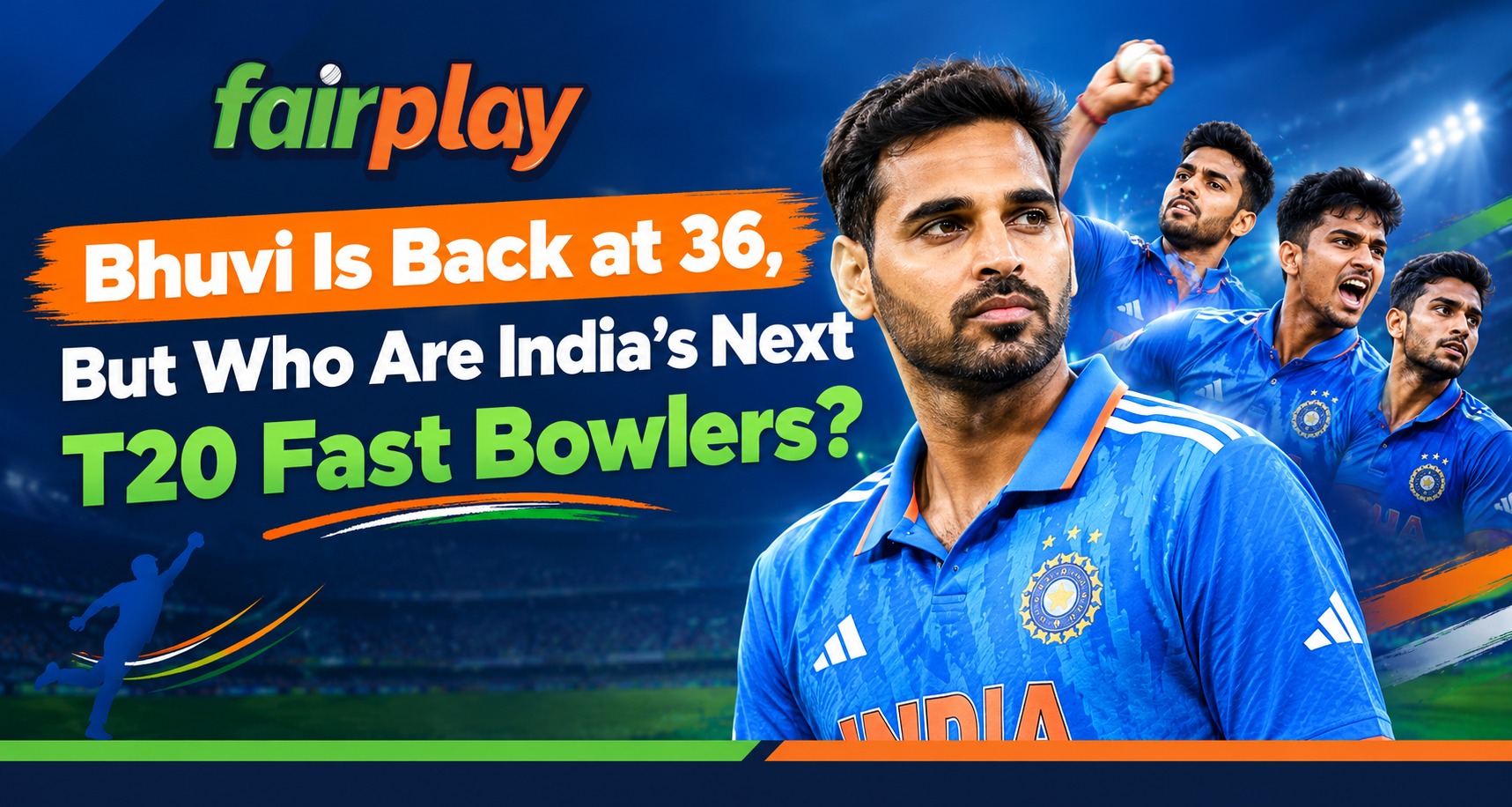
Bhuvneshwar Kumar’s return to India’s T20I squad at the age of 36 has become one of the talking points in Indian cricket. After nearly four years away from the national T20 setup, the experienced pacer has earned another opportunity following an impressive run for Royal Challengers Bengaluru. For Fairplay and cricket fans following India’s changing T20 setup, his comeback raises an interesting question: who will eventually take over from experienced fast bowlers like Bhuvi?
His return is not simply about age. It is about performance. Bhuvneshwar has shown that control, movement and experience can still be valuable in modern T20 cricket. At the same time, India needs to keep developing younger pacers who can handle international pressure.
Why Bhuvneshwar Kumar Is Back
Bhuvneshwar’s recall has been earned through his recent performances rather than reputation alone. During IPL 2026, he was one of Royal Challengers Bengaluru’s important bowling options and finished the season with 28 wickets. His ability to swing the new ball, bowl accurately and make adjustments has remained a major part of his game.
His experience is particularly useful in T20 cricket, where one or two overs can change a match. A bowler who understands when to attack, when to take pace off and how to bowl at different stages gives a captain another dependable option.
That makes his comeback understandable. India does not need to select players based purely on age. Current form and suitability for the conditions have to matter too.
The Bigger Question About India’s Fast-Bowling Future
While Bhuvneshwar’s return is a positive story for the player, it also highlights a longer-term challenge.
India has spent the last few years giving opportunities to younger fast bowlers. Yet the national team is still relying on experienced names when established players are rested or unavailable. India Today noted that India have tried a large number of fast bowlers since Bhuvneshwar’s previous T20I appearance, but only a small number have established themselves as regular options.
This does not mean India lacks talent. The bigger challenge is turning promising bowlers into dependable international performers.
Arshdeep Singh Leads the Next Wave
Arshdeep Singh is already one of the clearest examples of India’s younger T20 pace options. He has experience at international level and offers a useful combination of left-arm angle, variations and death-over skills.
His role is especially important because left-arm pace gives India a different option within the attack. Instead of simply searching for another bowler who can replace Bhuvneshwar, India can build a varied attack around different skills.
The goal should be to develop multiple reliable combinations rather than depend on one particular replacement.
Mayank Yadav and the Importance of Fitness
Mayank Yadav remains another fascinating name in India’s pace plans. His raw pace attracted significant attention, but fast bowling at international level requires more than speed.
Fitness, workload management, accuracy and the ability to repeat performances are equally important. For a young fast bowler, developing physically and learning how to manage the demands of T20 cricket can be as important as adding a few extra kilometres per hour.
India will need patience with players like Mayank. Rushing a promising bowler into an excessive workload could create more problems than it solves.
Prince Yadav Adds Another Option
Prince Yadav is also part of the current conversation around India’s T20 fast-bowling depth. His inclusion alongside Arshdeep Singh and Mayank Yadav in the squad for the New Zealand T20I series shows that the selectors are continuing to examine younger pace options.
The important point is that these players do not necessarily need to become the “next Bhuvneshwar Kumar.” Cricket has changed, and each bowler can develop a different role.
One might become a powerplay specialist, another could focus on death overs, while another may provide an attacking middle-overs option.
What Makes a Good T20 Fast Bowler Today?
Modern T20 cricket demands versatility. Raw pace can create pressure, but accuracy often creates wickets. A bowler needs to understand pitch conditions, match situations and individual batters.
Comfort under pressure is another major factor. Young bowlers may have the physical ability to bowl fast, but international cricket tests decision-making just as much.
For fans, this also improves the viewing experience. A varied bowling attack creates more tactical possibilities and makes matches less predictable. For platforms such as Fairplay, providing clear information around players, squads and match developments can help supporters understand these changes rather than simply follow the score.
Experience Still Has Long Term Value
Bhuvneshwar’s comeback also shows why experienced players should not automatically be written off.
His knowledge can be valuable beyond his own overs. Younger bowlers can learn from how he prepares, reads batters and handles difficult situations. His presence could therefore have value even if India gradually increases the responsibility given to younger pacers.
This is a thoughtful way to approach team building. Instead of choosing between experience and youth, India can use both while preparing for the future.
Read more : How Does Fairplay Customer Support Help With Account Issues?
India Needs a Sustainable Pace Pipeline
The long-term answer is not finding one player to replace Bhuvneshwar. India needs a steady pipeline of fast bowlers.
That means giving promising players enough domestic and franchise exposure, managing workloads carefully and allowing them to learn from setbacks. The pathway from promising young pacer to reliable international bowler rarely happens overnight.
Bhuvneshwar’s own career is a reminder that skill can evolve with experience. His recent resurgence has come after years of adjusting his fitness, preparation and approach to the game.
Conclusion
Bhuvneshwar Kumar being back at 36 is a reminder that cricket rewards performance, regardless of age. His return gives India an experienced T20 bowler at a time when the team is continuing to search for greater pace-bowling depth.
At the same time, India cannot depend on experienced players forever. Arshdeep Singh, Mayank Yadav, Prince Yadav and other emerging pacers need opportunities to develop into dependable international options.
For Fairplay, this makes India’s T20 fast-bowling transition an interesting story to follow. Bhuvi may still have plenty to offer, but the bigger question will remain: who is ready to carry India’s pace attack into the next generation?
FAQs
1. Why has Bhuvneshwar Kumar returned to India’s T20I squad?
Bhuvneshwar has been recalled after strong performances for Royal Challengers Bengaluru in IPL 2026. His control, swing and experience have helped him earn another opportunity.
2. How old is Bhuvneshwar Kumar?
Bhuvneshwar Kumar is 36 years old and has returned to India’s T20I setup after nearly four years away from the format.
3. Who are India’s emerging T20 fast bowlers?
Arshdeep Singh, Mayank Yadav and Prince Yadav are among the younger pace options currently being considered in India’s T20 setup.
4. Why is Bhuvneshwar still valuable in T20 cricket?
His ability to move the new ball, maintain control and adapt to different match situations makes his experience particularly useful in the shortest format.
5. Can Bhuvneshwar help India’s younger fast bowlers?
Yes. His experience can provide younger pacers with an opportunity to learn about preparation, bowling plans, match awareness and handling pressure at the international level.